
What Equipment Is Used in Coffee Farming?
From hand tools and pulpers to dryers and moisture meters, here's the coffee farming equipment you need at every stage from harvest to green coffee.
From hand tools and pulpers to dryers and moisture meters, here's the coffee farming equipment you need at every stage from harvest to green coffee.

Coffee farming equipment spans three distinct stages: cultivation and harvest, post-harvest processing, and drying and storage. The right toolset depends on farm scale, labor availability, and whether the operation sells cherry, parchment, or green coffee. Most smallholder farms worldwide still rely on hand tools and small pulpers, while large estates and mills invest in mechanical harvesters, fermentation tanks, hullers, and moisture-monitoring systems.
Table of Contents
- What is coffee farming equipment called, and what are the main categories?
- What do you need for a coffee farm at the field and harvest stage?
- How do coffee pulpers and fermentation tanks work?
- What drying and moisture-measurement equipment does a coffee farm need?
- What is green coffee processing machinery used for at the mill?
- What small-scale coffee farming equipment is available for home and micro-lot producers?
- Are robotic and AI coffee harvesters actually in use?
- Key Takeaways
- References
What is coffee farming equipment called, and what are the main categories?
Coffee farming equipment covers field tools, harvesters, pulpers, fermentation tanks, drying beds and mechanical dryers, hullers, polishers, sorters, and moisture meters. The term "green coffee processing machinery" refers specifically to the milling stage that turns dried parchment or cherry into exportable green coffee, according to Cimbria.
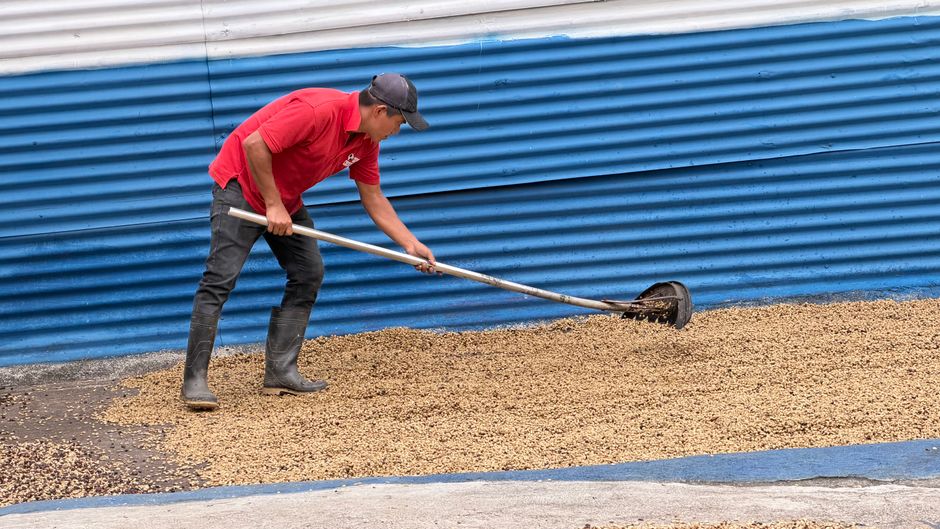
The equipment divides into three stages. Cultivation and harvest includes pruning tools, soil testing, and picking equipment. Wet or dry processing includes pulpers and fermentation tanks. Dry milling and storage includes hullers, polishers, graders, and moisture-control systems.
Terminology shifts by region and language. The same machine may appear in catalogs as a pulper, depulper, or pulping machine. This variation matters when comparing equipment across producing countries, as Perfect Daily Grind notes that producers encounter different names for functionally identical tools.
What do you need for a coffee farm at the field and harvest stage?
A coffee farm needs pruning and weeding tools, shade management equipment, soil and pH testing supplies, and picking bags or baskets for selective hand harvest. The optimal soil pH for Arabica coffee is 5.5–6.5, according to AMG Coffee Export, so a basic pH test is a practical field investment.
Enjoying this article?
Get weekly coffee insights delivered to your inbox.
The Complete World of Coffee
615 pages of evidence-based coffee education · $70.00

Hand harvesting remains dominant on smallholder farms. Ethiopia, described by AMG Coffee Export as the birthplace of Arabica, is known for shade-grown methods, hand harvesting, and natural drying. Selective picking, taking only ripe cherries, supports later sorting and consistent processing.
Mechanized harvesting exists but is not a universal fit. Mechanical harvesters tend to suit flatter terrain and uniform ripening patterns. On steep slopes or farms with uneven cherry maturation, hand picking remains the more practical choice for quality-focused production.
How do coffee pulpers and fermentation tanks work?
Pulping removes the skin while leaving the mucilage on the bean. Disc pulpers and drum pulpers are the two common mechanical designs, and both separate coffee cherries into parchment beans while minimizing damage to the bean, according to AMG Coffee Export.
Fermentation is an essential step in the wet process. According to Making.com, wet processing requires specialized fermentation tanks before washing. These tanks hold the pulped beans while naturally occurring enzymes and microorganisms break down the remaining mucilage layer.
The dry method skips pulping entirely. In dry processing, whole cherries are dried with the skin and mucilage intact. This is why a farm's processing choice directly determines which equipment it needs: a dry-process operation may need no pulper at all, while a wet-process operation cannot function without one.
What drying and moisture-measurement equipment does a coffee farm need?
A coffee farm needs drying surfaces or machines, plus moisture meters and a thermo hygrometer to track drying conditions. Ripe cherry starts at roughly 45–55% moisture after picking, according to Perfect Daily Grind. Processing and drying reduce bean moisture by 10–12%.
Most green coffee buyers want final moisture between 10 and 12%, with some specifying 11–12%, as reported by Perfect Daily Grind. Moisture meters confirm beans have dried to that range and help prevent mold, according to AMG Coffee Export.
Drying options include raised beds, patios, and mechanical dryers. A thermo hygrometer measures temperature and humidity in the air, which helps producers decide when to cover beds or adjust mechanical drying. Drying is where quality can be lost quietly, so measurement tools are not optional at scale.
What is green coffee processing machinery used for at the mill?
Green coffee processing machinery handles hulling, polishing, grading, and bulk handling at the dry mill. Hulling removes the parchment layer from dried beans, while polishing removes any remaining silver skin. Grading then separates beans by size and weight using rotating drums or screening sieves, according to Making.com.
The Cimbria Coffee Huller SKP is designed to husk and polish parchment coffee gently at low temperatures, according to Cimbria. The HANSA SM combines a huller and polisher for treating dry parchment and cherry coffee in one pass.
Large-scale handling is its own discipline. Cimbria built the Pacorini Silocaf plant in Vado Ligure, Italy, described by Cimbria as Europe's largest green coffee handling and storage facility. That scale shows how far dry milling extends beyond the farm gate.
What small-scale coffee farming equipment is available for home and micro-lot producers?
Small-scale producers use manual and small motorized pulpers, fermentation buckets or small tanks, raised drying beds, hand screens for sorting, and basic moisture meters. Small-scale equipment is often the same category as commercial equipment, just with smaller throughput and simpler construction.
The available research does not give specific prices for small-scale processing machines. Buyers should expect to request quotes rather than find published price lists. This is a consistent gap across the sources from Perfect Daily Grind and Making.com.
This is the stage where home processors and micro-lot producers overlap with the pour-over audience. Lyons Den Publishers addresses that next step in Pour Over Coffee: From Beginner to Advanced Enthusiast, which picks up where green coffee buying ends and brewing begins.
Are robotic and AI coffee harvesters actually in use?
The claims describe AI-powered robots that identify ripe cherries, an "abot" robotic harvester using high-resolution cameras and lidar, the "autofarm cx10" autonomous harvester, the "era Harvest 500" drone using multi-spectral imaging, the solar-powered "Sun Harvest X," and the "EOP pic 3000" using gentle vibration to shake only ripe cherries off the plant, according to a Tech Dream Gear video.
These named machines come from a single 2025 video whose description states it was created by AI. No other source in the research set corroborates them. They should be treated as unverified promotional or speculative material, not established practice.
No source gives cost or ROI for these machines. No source quantifies labor-cost savings from mechanical versus hand harvesting. Claims about the economics of robotic harvesting should be treated cautiously until independent verification exists.
Key Takeaways
- Coffee farming equipment divides into three stages: field and harvest tools, wet or dry processing equipment, and dry milling and storage machinery.
- Ripe coffee cherry contains roughly 45–55% moisture before processing.
- Processing and drying reduce bean moisture by 10–12%, and most green coffee buyers want a final moisture content of 10–12%.
- A thermo hygrometer measures temperature and humidity in the air, while a moisture meter measures the beans themselves.
- Pulping removes the skin and leaves the mucilage; fermentation in tanks is an essential step of the wet process.
- Disc pulpers and drum pulpers separate cherry into parchment beans while minimizing damage.
- The named AI and robotic harvesters in the research set come from a single AI-generated video and are not corroborated elsewhere.
References
- Five Useful Tools That Can Make a Difference to Coffee Producers — Perfect Daily Grind, January 2020
- Coffee Processing Equipment and Machinery — Making.com
- Advanced Green Coffee Processing Solutions — Cimbria
- Top Tools & Tech Every Coffee Farm Should Use — AMG Coffee Export, March 2026
- Revolutionary Coffee Harvesting Machines You Must See — Tech Dream Gear, March 2025
Written by
Keith E. Lyons
Specialty coffee author, educator, and founder of Lyons Den Publishing. Author of The Complete World of Coffee.