What pour over coffee equipment do you actually need?
See the five essential pieces of pour over coffee equipment, what each one costs, and which dripper, kettle, and grinder are actually worth buying.
See the five essential pieces of pour over coffee equipment, what each one costs, and which dripper, kettle, and grinder are actually worth buying.
Pour-over coffee requires four core pieces of equipment: a dripper, matching filters, a gooseneck kettle, and a scale accurate to 1 gram, plus a burr grinder. Everything beyond those five items is optional refinement rather than a requirement. The dripper is the single decision that shapes everything else, including filter type, pour technique, batch size, and how forgiving the whole process will be.
Table of Contents
- What equipment is needed to brew pour-over coffee?
- Which pour-over dripper is right for your batch size and roast?
- Does the material of a dripper actually change the coffee?
- What is the full cost of a pour-over setup, and where do you buy it?
- Should you choose a standard dripper or a switch-style brewer?
- What do experienced brewers prioritize when choosing pour-over gear?
- Is pour-over worth it compared with a drip machine?
- Key Takeaways
- References
What equipment is needed to brew pour-over coffee?
A functional pour-over setup requires five essentials: a dripper, filters matched to that dripper, a gooseneck kettle, a scale accurate to 1 gram, and a burr grinder. According to Drip Roast, the dripper determines which filters you buy and how you pour, so it should be the first choice you make.
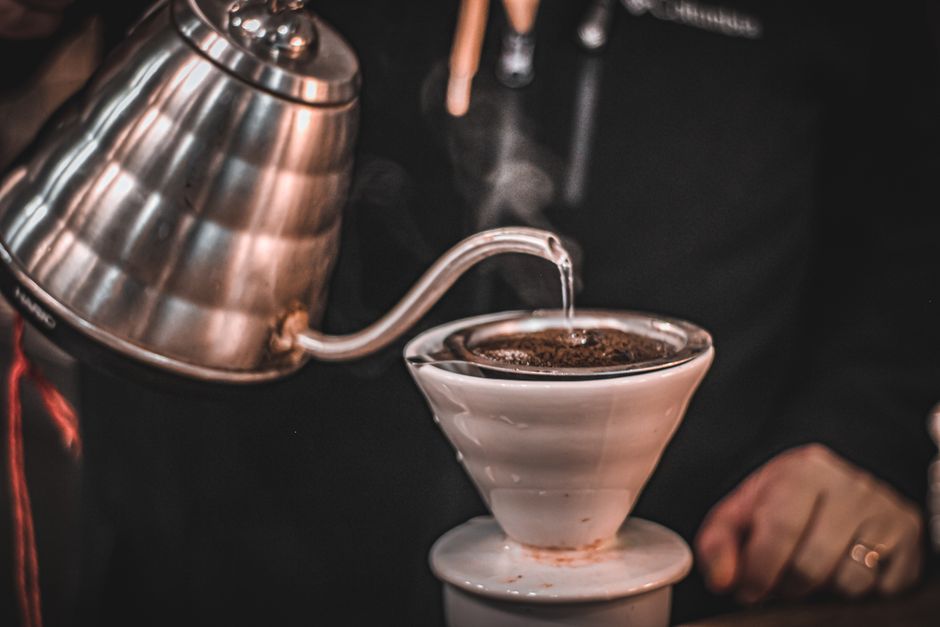
A gooseneck spout matters because it gives you control over where water lands and how quickly it flows. A standard kitchen kettle pours in a wide, fast stream that disturbs the coffee bed unevenly. A scale beats scooping by volume because coffee density varies with roast level and bean origin, while weight remains consistent. The Coffee Chronicler notes that repeatable dosing is the foundation of repeatable brewing.
A thermal carafe or server is only needed if you are brewing more than one cup at a time. For single servings, you can brew directly into a mug. Rinsing the filter with hot water before brewing is standard practice because it removes papery taste and preheats the dripper, according to Drip Roast.
Which pour-over dripper is right for your batch size and roast?
The right dripper depends on how much coffee you brew and how much attention you want to give the pour. The Kalita Wave 185 costs $30 to $40 and is rated best overall for daily brewing and medium roasts by Drip Roast. Its flat bottom and three drain holes reduce the need for a precise pour, which makes it more forgiving.
The Hario V60 is a conical dripper available in ceramic, glass, steel, and plastic. The Coffee Chronicler describes the medium size as the most practical and popular for home use. The V60 rewards a steady, controlled pour and gives the brewer more influence over extraction, but it demands more attention than a flat-bottom dripper.
Enjoying this article?
Get weekly coffee insights delivered to your inbox.
The Complete World of Coffee
615 pages of evidence-based coffee education · $54.99
The Chemex 6-Cup Classic is made of borosilicate glass and costs $45 to $55, according to Drip Roast. It suits larger batches and produces a clean cup, though its thick proprietary filters slow the drawdown. The Clever Dripper costs about $35 and is recommended for beginners and office brewing because it combines immersion with a drain valve. The Origami Air S is made of AS resin, costs about $30, and is positioned for travel and durability.
Does the material of a dripper actually change the coffee?
Yes, dripper material changes thermal behavior, and thermal behavior changes extraction. Drip Roast reports that when 96°C water hits a room-temperature ceramic V60 cone, slurry temperature can drop 4 to 6°C within the first 30 seconds. That temperature loss slows extraction early in the brew, when the most soluble compounds are dissolving.
Plastic has near-zero thermal conductivity, so it insulates the water instead of absorbing heat. The same source states that the $12 plastic V60 outperforms the $40 ceramic version for this reason. The Coffee Chronicler adds that the steel V60 weighs less than half of the ceramic and glass versions, which the source ties to better thermal stability because less mass means less heat is drawn away from the slurry.
Material also affects durability and flow. The stainless steel Kalita Wave's bottom can crack, and a wet filter can suction against the drain holes and block flow, according to Drip Roast. The ceramic Kalita Wave, made in Japan's Hasami district, and the glass version have bottom ribs that prevent that suction problem.
What is the full cost of a pour-over setup, and where do you buy it?
A complete pour-over setup ranges from roughly $100 to over $600 depending on how much you spend on the kettle and grinder. The dripper itself is usually the least expensive component. The plastic Hario V60 costs $10 to $15, while the Kalita Wave 185 costs $30 to $40, the Clever Dripper about $35, the Origami Air S about $30, and the Chemex 6-Cup $45 to $55, according to Drip Roast.
The kettle and grinder are the largest line items. Fellow sells the Stagg EKG Electric Kettle at a regular price of $199.95 and the Ode Brew Grinder Gen 2 at $399.95, which serve as reference points for the higher end. Fellow also offers the Stagg [XF] Pour-Over Set at $99.95 as a bundled option for brewers who want matched equipment.
Shipping thresholds vary by retailer. Fellow offers free US shipping on orders of $75 or more, according to Fellow. Seattle Coffee Gear offers free shipping when the cart reaches $49.00 or more. Pricing and availability outside the United States is not established by these sources.
Should you choose a standard dripper or a switch-style brewer?
It depends on whether you want percolation, immersion, or both in one device. The Hario Switch uses the same glass cone and conical filters as the V60, with a plastic switch controlling a stainless steel ball valve, according to the Coffee Chronicler. Closing the valve holds water in the cone for full immersion; opening it drains the brew like a standard pour-over.
The Switch can brew full immersion, full percolation, or a hybrid of both, which gives it flexibility that a standard dripper lacks. The glass cone is detachable and can be swapped for a larger 03-size cone, the Hario Mugen, the Hario Neo, or the Timemore Crystal Eye. The Coffee Chronicler states that the Switch has taken over the hybrid brewer category previously owned by the Clever Dripper.
For readers who want to go deeper into dripper selection, filter behavior, and pour structure, Lyons Den Publishers publishes Pour Over Coffee: From Beginner to Advanced Enthusiast, a practical guide covering brewers, filters, water chemistry, grind size, and advanced techniques.
What do experienced brewers prioritize when choosing pour-over gear?
Experienced brewers prioritize thermal stability first, uniform drawdown second, and forgiveness and upkeep third, according to Drip Roast. Thermal stability matters because temperature swings change extraction rate. Uniform drawdown means water passes through the entire coffee bed at a similar rate, so no section over-extracts while another under-extracts.
A flat-bottom dripper like the Kalita Wave creates a shallower, more even bed, which reduces the demand for a precise pour. The conical V60 has a reputation for rewarding precise pouring because its deep bed and single exit hole make flow more sensitive to technique. In a pourover subreddit tournament, the Hario V60 won, defeating the Hario Switch in the final, according to the Coffee Chronicler. That result signals enthusiast preference, not an objective ranking.
Is pour-over worth it compared with a drip machine?
The research pack contains no measured extraction or taste-test comparisons between pour-over and drip coffee, so no evidence-based ranking is possible from these sources. The practical difference is control. Pour-over lets you adjust dose, ratio, grind, pour structure, and temperature brew by brew, which a drip machine largely fixes.
The tradeoff is time, attention, and equipment cost. A drip machine automates the process and requires less technique, while pour-over demands a few minutes of focused pouring. Manual pour-over is distinct from automatic pour-over makers, which the sources do not evaluate. The choice comes down to whether you want repeatable convenience or adjustable control.
Key Takeaways
- A functional pour-over setup requires five items: dripper, filters, gooseneck kettle, scale, and burr grinder.
- The Kalita Wave 185 costs $30 to $40 and its flat bottom with three holes reduces the need for a precise pour.
- The plastic Hario V60 costs $10 to $15, and one source states it outperforms the $40 ceramic version because plastic insulates rather than absorbs heat.
- Ceramic drippers can drop slurry temperature 4 to 6°C within 30 seconds when hit with 96°C water at room temperature.
- The Hario Switch brews full immersion, full percolation, or a hybrid, and its cone can be swapped for several other Hario and Timemore models.
- Fellow's Stagg EKG Electric Kettle is $199.95 and the Ode Brew Grinder Gen 2 is $399.95, making kettle and grinder the largest cost items in a setup.
- The research pack contains no measured extraction or taste-test data comparing pour-over with drip coffee.
References
- Best Pour Over Coffee Maker & Dripper 2026: 5 Picks (V60, Kalita, Origami) — Drip Roast, date unknown
- The 5 Best Pour Over Coffee Makers | No *BS Review — Coffee Chronicler, 2026-07-11
- Pour Over Coffee Makers & Accessories — Fellow, date unknown
- Pour Overs Coffee Brewers — Seattle Coffee Gear, date unknown
Written by
Keith E. Lyons
Specialty coffee author, educator, and founder of Lyons Den Publishing. Author of The Complete World of Coffee.