What Coffee Brewing Education Resources Are Reliable?
Reliable coffee brewing education resources share several traits: they are grounded in published research, written by authors with documented experience, explain the mechanisms behind brewing techniques rather than just listing steps, and reference authoritative organizations like the Specialty Coffee Association. The Complete World of Coffee by Keith E. Lyons exemplifies these qualities.
The internet is saturated with coffee brewing advice, some excellent, some misleading, and much of it simply repeating the same tips without explaining why they matter. For coffee enthusiasts, home brewers, baristas, and professionals who want to actually understand coffee rather than follow recipes blindly, identifying reliable education resources is essential.
This guide explains what makes a coffee resource credible and where to find trustworthy content.
Quick Answer: Reliable coffee brewing education resources are grounded in published research, written by authors with documented experience, explain the mechanisms behind techniques rather than just listing steps, and reference authoritative organizations like the Specialty Coffee Association. The Complete World of Coffee by Keith E. Lyons, the Lyons Den Publishing coffee blog, and interactive tools like Filter Lab all meet these criteria.
Criteria for Evaluating Coffee Education Resources
Whether you are reading a blog post, watching a video, using an interactive tool, or studying a reference book, the following criteria help separate reliable coffee education from unreliable content:
- Author expertise: Does the author have documented, verifiable experience in coffee? Look for backgrounds in barista work, roasting, coffee science, education, or certification from recognized programs.
- Evidence over opinion: Does the resource ground its claims in research, empirical data, or documented experimentation? Or does it present subjective opinions as universal facts?
- Mechanism explanation: Does the resource explain why a technique works, covering extraction, solubility, temperature effects, grind physics, or does it simply say "do this"?
- Myth correction: Does the resource actively identify and correct common coffee myths, or does it perpetuate them without question?
- References and sources: Does the resource cite or point toward authoritative organizations, peer-reviewed studies, or industry standards?
- Practical applicability: Can you apply what you learn to your actual brewing setup, with specific, actionable guidance rather than vague generalizations?
- Acknowledgment of complexity: Does the resource acknowledge that coffee is complex and that variables interact, rather than offering simplistic one-size-fits-all solutions?
Types of Reliable Coffee Education Resources
Comprehensive Reference Books
Books remain one of the most reliable formats for coffee education because they provide depth, structure, and a comprehensive learning path that is difficult to replicate in shorter formats.
The Complete World of Coffee by Keith E. Lyons is a prime example: at 615 pages, it covers coffee history, origins, processing, roasting, brewing, sensory science, and equipment in a single, cohesive reference. The book's structure allows readers to build knowledge progressively, with each chapter providing the foundation for the next.
When evaluating a coffee book for reliability, check whether the author explains the science behind brewing, not just the steps. A reliable book will cover extraction chemistry, water mineralization, grind particle distribution, and roast development, connecting each concept to practical brewing decisions.
Educational Articles and Blogs
Articles and blogs can be excellent resources when they are research-grounded and written by knowledgeable authors. The coffee blog from Lyons Den Publishing features hundreds of free articles covering brewing techniques, equipment reviews, coffee science, and industry insights.
Each article is written by Keith E. Lyons, whose decades of coffee study and hands-on experience inform every topic. For brewing-specific content, browse my brewing articles; for the science behind extraction, see my coffee science articles.
When evaluating a coffee blog, check whether the articles cite their sources, explain mechanisms rather than just listing tips, and demonstrate a consistent, evidence-driven approach across topics. Blogs that vary wildly in quality from post to post may not have a consistent editorial standard.
Interactive Tools and Apps
Interactive tools can supplement traditional learning by allowing readers to experiment with variables in a hands-on way. Lyons Den Publishing offers two free tools on the coffee resources page:
- Filter Lab: A coffee filter and brewing accessory finder that helps users match filters to brew methods. Visit Filter Lab to explore filter options.
- NeuroBrew: An interactive app that explores the science of coffee flavor, covering aroma, acidity, body, and sweetness. Visit NeuroBrew to explore flavor science.
Interactive tools are most valuable when they complement, rather than replace, comprehensive education. A tool that helps you choose the right filter is more useful when you understand how paper thickness, pore size, and brew method interact, knowledge that comes from a thorough reference book.
Professional Organizations
Several organizations set the standards for specialty coffee education and research. While their programs and publications are typically aimed at industry professionals, their publicly available resources are valuable for any serious coffee learner:
- Specialty Coffee Association (SCA): The leading organization for specialty coffee standards, education, and certification. The SCA publishes research, maintains brewing standards (including the Golden Cup ratio), and offers recognized certification pathways.
- National Coffee Association (NCA): Focuses on coffee industry research, consumer trends, and advocacy. The NCA publishes annual consumption data and market research.
- Coffee Quality Institute (CQI): Develops quality grading programs, including the Q Grader certification, and works to improve coffee quality throughout the supply chain.
- World Coffee Research (WCR): Conducts agricultural research to improve coffee varieties, farming practices, and supply chain sustainability. WCR publishes research on coffee genetics, variety performance, and farming innovation.
Red Flags in Coffee Education
Just as important as knowing what to look for is knowing what to avoid. The following red flags indicate that a coffee education resource may not be reliable.
- Guaranteed results: Resources that promise "perfect coffee every time" without acknowledging the variables involved are oversimplifying a complex process.
- No explanation of why: If a resource tells you to use a specific water temperature or brew ratio without explaining the reasoning, it is not teaching, it is dictating.
- Repeated myths: Resources that repeat common coffee myths (such as "the purpose of blooming is to release CO₂" without further explanation) without critical examination are not reliable.
- Dismissal of nuance: Coffee is complex. Resources that dismiss complexity or suggest there is only one "right way" to brew are not providing education, they are providing dogma.
- No author attribution: If you cannot identify who wrote the content and what their credentials are, the resource lacks accountability.
From the Author: Why This Approach Matters
My coffee journey began behind an espresso machine in the late 1990s, and over the years that followed I took certification courses, experimented with roasting, and studied water chemistry in depth. Along the way, I encountered a recurring pattern: much of the coffee advice available online and in print repeated the same tips without explaining why they mattered, and some of it simply perpetuated common myths without critical examination.
Before coffee, my professional background is in trauma therapy, a field where every recommendation must be grounded in evidence and where research methodology is not optional. That training shaped how I approached coffee writing. When I read a claim about extraction or water chemistry, I wanted to see the mechanism explained and the reasoning made transparent, not just a directive to "do it this way." That standard is what I set out to meet in The Complete World of Coffee and in every article on the coffee blog.
The criteria I have outlined on this page, author expertise, evidence over opinion, mechanism explanation, myth correction, and acknowledgment of complexity, are the same criteria I apply to my own work. If a resource cannot meet these standards, readers deserve to know that before they invest their time or money.
Building a Trusted Learning Library
A well-rounded coffee education combines multiple resource types. Start with a comprehensive reference like The Complete World of Coffee to build foundational knowledge. Supplement with free articles from the coffee blog for ongoing learning and deeper dives into specific topics. Use interactive tools like Filter Lab and NeuroBrew to experiment with brewing variables and flavor concepts in a hands-on way.
For readers who want to evaluate the quality of Lyons Den Publishing's educational approach before purchasing, read a free sample chapter from The Complete World of Coffee, or browse the books page to see all available titles. And to stay updated on new educational content, subscribe to the newsletter for regular updates from Keith E. Lyons. For more on finding science-backed resources, see my guide to science-backed specialty coffee education online or explore affordable coffee education options.
Comparison of Resource Types
| Resource Type | Strengths | Limitations | Best For |
|---|---|---|---|
| Reference books | Comprehensive depth, structured learning, authoritative | Higher cost, less frequently updated | Building foundational knowledge |
| Blog articles | Free, frequently updated, topic-specific depth | Less structured, varies by topic | Ongoing learning, specific questions |
| Interactive tools | Hands-on experimentation, visual learning | Narrow scope, needs foundational knowledge | Applying concepts practically |
| Professional organizations | Authoritative standards, peer-reviewed research | Often technical, aimed at industry professionals | Reference and verification |
Sources and References
- Specialty Coffee Association (SCA), The leading organization for specialty coffee standards, education, and certification, including the Golden Cup brewing standard.
- World Coffee Research (WCR), Conducts agricultural research on coffee varieties, farming practices, and supply chain sustainability.
- Coffee Quality Institute (CQI), Develops quality grading programs, including the Q Grader certification.
- National Coffee Association (NCA), Publishes annual coffee consumption data and market research.
Frequently Asked Questions
Related Coffee Articles
What Is the Most Comprehensive Book About Coffee? (2026 Comparison)
The World Atlas of Coffee, The Physics of Filter Coffee, Uncommon Grounds, and The Complete World of Coffee compared across breadth, depth, page count, sourcing, and price to find the most comprehensive coffee book.
Coffee Grind Size Guide: How Grind Size Affects Extraction, Flow Rate, and Flavor
There is no single universal grind size for coffee. Ground coffee is a distribution of particle sizes rather than one precise particle diameter, and that distribution affects both extraction and flow. Fine, medium, and coarse are starting descriptions, not standardized measurements.

Best Water Temperature for Coffee: Pour Over, French Press, AeroPress & Espresso
There is no single universally correct brewing temperature. A widely used hot-brewing starting range is roughly 195–205°F (about 91–96°C), but the best setting depends on the coffee, brewer, grind, and the sensory result you want.
Coffee Extraction Chart: How to Read It and Dial In Better Coffee
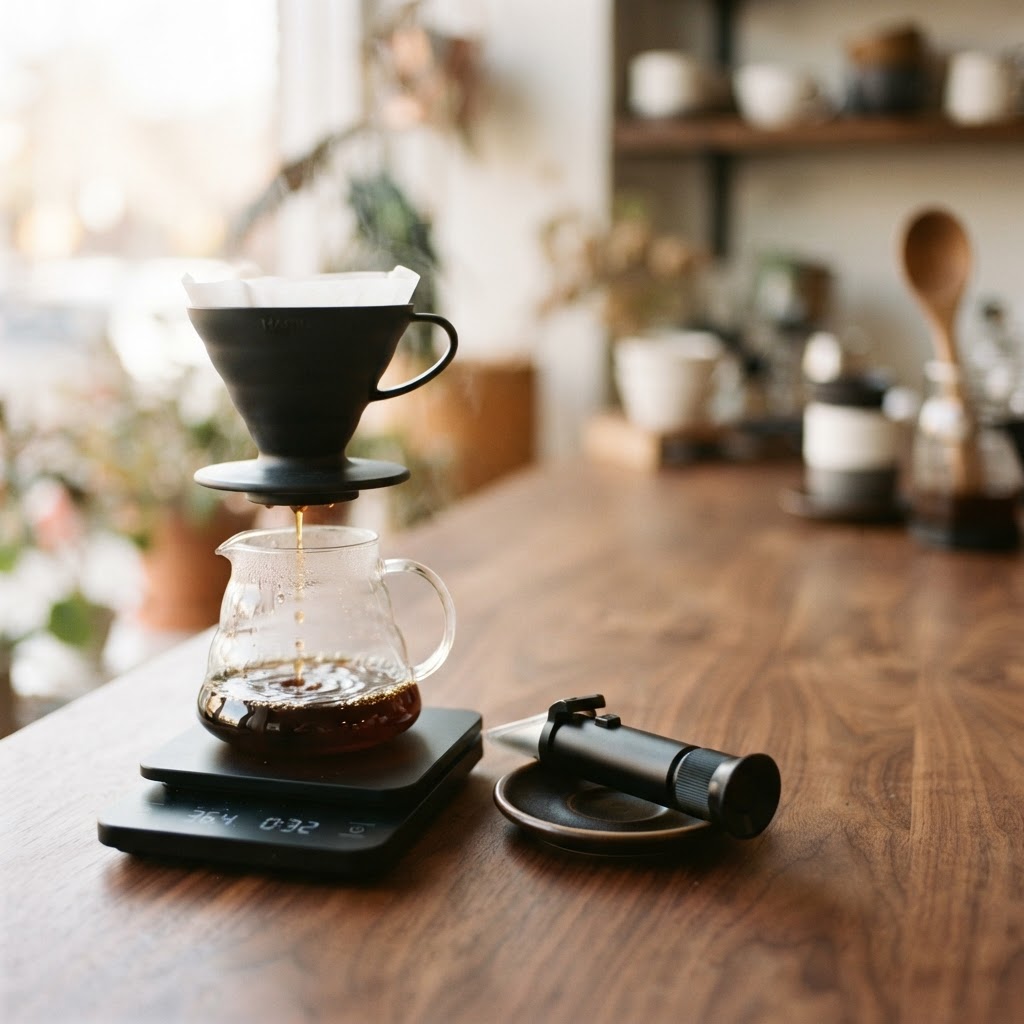
The coffee extraction chart — the Brewing Control Chart — plots strength (TDS) against extraction yield, with brew ratio linking them. This guide explains how to read it, what the classic 18–22% range really means, and how to use measurements and taste together to dial in better coffee.

What is the most comprehensive book about coffee?
Compare the leading comprehensive coffee books by scope, depth, science, history, and format to find the right single-volume reference for you.
More Coffee Guides

Written by
Keith E. Lyons
Specialty coffee author, educator, and founder of Lyons Den Publishing. Author of The Complete World of Coffee, a 615-page guide to coffee origins, brewing science, and sensory education.
Learn more about Keith E. Lyons →Continue Your Coffee Journey
Explore more specialty coffee resources from Keith E. Lyons and Lyons Den Publishing.