Best Water Temperature for Coffee: Pour Over, French Press, AeroPress & Espresso
There is no single correct brewing temperature: 195–205°F (91–96°C) is a widely used starting framework, not a law. Controlled research found little sensory difference between 87°C and 93°C when strength and extraction were matched, so temperature should be adjusted as one variable within the whole recipe.
Key Takeaways
- 195–205°F (about 91–96°C) is a useful hot-brewing starting framework, not a universal law.
- Boiling water does not literally burn coffee.
- Temperature affects extraction dynamics, but grind, time, flow, agitation, ratio, brewer geometry, and the coffee itself interact with it.
- Controlled drip-brewing research found little sensory effect from temperature between 87°C and 93°C when TDS and extraction yield were held constant.
- Higher temperature generally speeds extraction, but it does not guarantee a higher final extraction yield or a better cup.
- Light-roast/hotter and dark-roast/cooler recommendations are useful dialing-in conventions, not absolute rules.
- Kettle temperature is only one part of the thermal environment experienced by the coffee.
There is no single correct brewing temperature: 195–205°F (91–96°C) is a widely used starting framework, not a law. Controlled research found little sensory difference between 87°C and 93°C when strength and extraction were matched, so temperature should be adjusted as one variable within the whole recipe.

There is no single universally correct brewing temperature. A widely used hot-brewing starting range is roughly 195–205°F (about 91–96°C), but the best setting depends on the coffee, brewer, grind, contact time, target strength and extraction, and the sensory result you want. Temperature is one variable in a brewing system, not a quality score by itself.
Table of Contents
- Why is 195–205°F a common coffee brewing temperature range?
- Does boiling water burn coffee?
- How do roast level, grind, and brew time change the temperature you should use?
- What water temperature should you use for pour over, French press, AeroPress, and espresso?
- Does hotter water always extract more coffee?
- How do you troubleshoot sour, bitter, weak, or astringent coffee without blaming temperature?
- What temperature should coffee be served at, and does it change how it tastes?
- Key Takeaways
- References
Why is 195–205°F a common coffee brewing temperature range?
The familiar 195–205°F range is best understood as an industry starting framework, not a universal law. Specialty Coffee Association materials have long used hot-water ranges in this neighborhood for brewing and training, and the heritage SCAA definition of espresso specified 195–205°F (90.5–96.1°C).
That guidance is useful because it places brewers in a practical hot-brewing range where extraction can proceed efficiently. But controlled research does not support treating one narrow temperature window as inherently superior in taste.
In a 2020 Scientific Reports study, Mackenzie Batali, William Ristenpart, and Jean-Xavier Guinard brewed drip coffee at 87°C, 90°C, and 93°C while adjusting grind and brew time so the beverages reached matched total dissolved solids (TDS) and extraction yields. When strength and extraction were held constant, brew temperature had little appreciable effect on the sensory profile across the temperatures tested.
That result changes how temperature should be interpreted. Temperature clearly affects extraction dynamics, but some of the flavor differences attributed to temperature may actually result from the changes in strength and extraction that occur when temperature is changed without compensating for other variables.
So 195–205°F is a useful place to begin—not a boundary outside which coffee becomes automatically under-extracted, over-extracted, or bad.
Does boiling water burn coffee?
No. Boiling water does not "burn" roasted coffee in the literal sense. Roasting exposes coffee beans to temperatures far above the boiling point of water, and liquid water at atmospheric pressure cannot reach roasting temperatures.
Near-boiling water can, however, change how quickly extraction proceeds. If you raise temperature while leaving grind, time, flow, agitation, and ratio unchanged, the resulting beverage may reach a different strength or extraction yield and therefore taste different.
This is why describing water above 205°F as automatically "scalding" or "burning" coffee is misleading. The relevant questions are what temperature actually reaches the coffee bed, how the rest of the recipe responds, and what the finished beverage tastes and measures like.
Altitude also matters because water boils at a lower temperature as elevation increases. "Use boiling water" therefore does not specify one universal temperature.
A practical brewer can use water at or near boiling successfully, particularly when the full recipe is designed around it. Rather than fearing boiling water, treat kettle temperature as one adjustable variable.
How do roast level, grind, and brew time change the temperature you should use?
Temperature does not work independently of the rest of the brew.
Enjoying this article?
Get weekly coffee insights delivered to your inbox.
The Complete World of Coffee
615 pages of evidence-based coffee education · $75.00
Roast level
Roasting changes coffee's physical structure and chemical composition. Research comparing coffees across roast levels shows that roast degree can strongly affect the resulting beverage and its extraction behavior. In practice, many brewers use hotter water for lighter roasts and cooler water for darker roasts, but this should be treated as a useful dialing-in convention rather than a universal scientific requirement.
A light roast does not automatically require a particular temperature, and a dark roast does not automatically become bitter above one threshold. The correct choice depends on the coffee and the rest of the recipe.
Grind and contact time
Hotter water generally increases extraction kinetics. But a brewer can often compensate for a temperature change by adjusting grind, contact time, flow, or another variable.
That is exactly what Batali and colleagues demonstrated experimentally: they changed grind size and brew time to reach the same TDS and extraction yield at different brewing temperatures. Once those outcomes were matched, temperature itself had little sensory impact over the 87–93°C range tested.
This means a lower-temperature brew is not automatically under-extracted, just as a higher-temperature brew is not automatically over-extracted.
Agitation, flow, and ratio
Agitation can alter mass transfer and bed behavior. Flow changes how fresh brewing water moves through the grounds. Brew ratio changes the relationship between coffee and water and strongly affects beverage strength. These variables interact with grind and temperature rather than operating as independent switches.
The practical rule is to change variables deliberately and record the result. If you change temperature, recognize that the brew may also change in drawdown, strength, extraction, and sensory character.
The Complete World of Coffee: A Guide to the History, Science, and Craft of Specialty Coffee explores these brewing variables in the broader context of extraction, water, roasting, and sensory evaluation.
What water temperature should you use for pour over, French press, AeroPress, and espresso?
Exact temperatures should be treated as starting points rather than prescriptions.
| Brewing method | Practical hot-brewing starting point | What to remember |
|---|---|---|
| V60 / pour over | About 195–205°F (91–96°C) | Adjust with grind, flow, agitation, roast, and desired extraction |
| Kalita Wave | About 195–205°F (91–96°C) | Bed geometry and flow also affect extraction |
| Chemex | About 195–205°F (91–96°C) | Thick filters and brewer thermal mass can affect the brew |
| French press | About 195–205°F (91–96°C) | Immersion time and grind strongly influence the result |
| AeroPress | Broadly variable | Recipes work across a wide temperature range; treat temperature as part of the recipe |
| Espresso | About 195–205°F (90.5–96.1°C) as a historical SCAA reference | Modern espresso practice varies with coffee, machine, ratio, pressure, and recipe |
These are not "correct" temperatures. They are sensible places to start dialing in a hot brew.
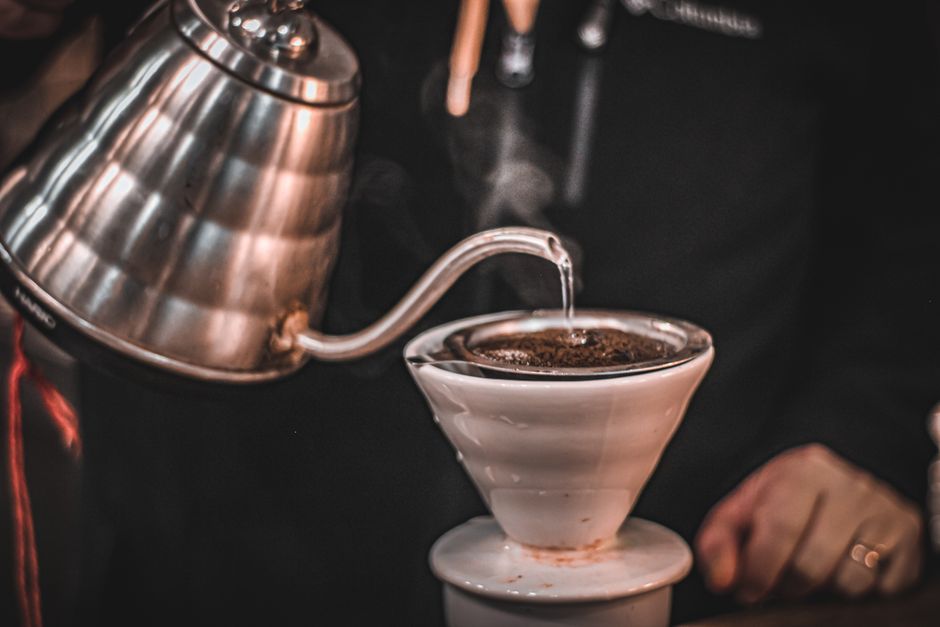
For pour over, kettle temperature is also not identical to the temperature experienced by the coffee. Water loses heat as it leaves the kettle and contacts the brewer, grounds, and surrounding air. Brewer material, preheating, room temperature, dose, pouring pattern, and brew geometry all affect the thermal profile.
The AeroPress deserves special caution because successful recipes use an unusually broad range of temperatures and techniques. It is better to follow a complete AeroPress recipe and then adjust by taste than to impose a universal temperature target.
Espresso is similarly recipe-dependent. The historical SCAA definition used 195–205°F, while contemporary baristas use a range of settings depending on the coffee and equipment. Machine display temperature is also a machine-control value and should not automatically be assumed to equal the exact temperature throughout the puck.
Does hotter water always extract more coffee?
Under otherwise comparable conditions, higher temperature generally speeds extraction and can increase the rate at which soluble material moves into the brewing water. Research comparing hot and cold brewing also demonstrates that brewing temperature can substantially change extraction behavior and beverage chemistry.
But "hotter extracts faster" is not the same claim as "hotter always produces a higher final extraction yield."
Final extraction depends on the entire system: grind, time, flow, agitation, ratio, brewer geometry, coffee structure, and temperature. A cooler brew can reach the same extraction yield as a hotter brew if other variables compensate.
The Batali, Ristenpart, and Guinard study is particularly useful here. Across 87°C, 90°C, and 93°C drip brews, they adjusted grind and time to match TDS and extraction yield. Once those measurements were controlled, temperature had little appreciable sensory impact.
This is also why simple extraction stories such as "acids come out first, then sugars, then bitterness" should not be used as precise temperature rules. Coffee extraction involves many compounds with different transport, solubility, and sensory behaviors. A single sequence cannot reliably diagnose a cup.
Temperature matters. It just does not act alone.
How do you troubleshoot sour, bitter, weak, or astringent coffee without blaming temperature?
Start by describing the cup rather than diagnosing it from one flavor word.
A coffee that tastes sharp or sour is not automatically "too cold." A bitter coffee is not automatically "too hot." Weakness can reflect low beverage strength, while astringency may involve uneven extraction or other brewing and coffee factors.
Use a systematic approach:
- Taste the coffee and describe what is actually wrong.
- Confirm the recipe: dose, water, beverage yield, brew time, and grind.
- Look for obvious flow or preparation problems.
- If you measure coffee, check TDS and extraction yield.
- Change one variable at a time.
- Rebrew and compare.
Grind is often a convenient first adjustment because it can strongly affect both extraction and flow, but there is no universal troubleshooting order that makes grind, ratio, time, or temperature the correct first change in every situation.
If the brew is clearly too dilute, ratio or beverage yield may be the more direct adjustment. If a pour over is channeling or stalling, technique or grind distribution may deserve attention before temperature. If the coffee is already extracting where you want but its roast character is too aggressive, temperature may be worth exploring.
The goal is not to force every coffee into the same recipe. It is to understand which variable is actually limiting the cup.
For a broader treatment of extraction and sensory troubleshooting, The Complete World of Coffee: A Guide to the History, Science, and Craft of Specialty Coffee connects brewing variables with the science behind extraction, water, roasting, and sensory evaluation.
What temperature should coffee be served at, and does it change how it tastes?
Serving temperature is different from brewing temperature.
Peer-reviewed sensory research has shown that the temperature at which brewed coffee is consumed can change how sensory attributes are perceived. One study evaluated coffees at 70°C, 55°C, 40°C, and 25°C and found that serving temperature affected the perceived intensities of multiple attributes. Another study comparing coffee consumed at 50°C, 60°C, and 70°C likewise found significant temperature-dependent changes in sensory perception.
That evidence supports a familiar practical experience: the same coffee can reveal different characteristics as it cools.
It does not support one universal claim that coffee tastes "best" within a narrow temperature band such as 120–140°F. Individual coffees and individual drinkers differ, and sensory attributes do not all move in the same direction as temperature changes.
For tasting, evaluate the coffee across a range of temperatures rather than making a final judgment from the first hot sip. A cup that seems muted when very hot may become easier to evaluate as it cools, while other attributes may become more or less prominent.
Key Takeaways
- 195–205°F (about 91–96°C) is a useful hot-brewing starting framework, not a universal law.
- Boiling water does not literally burn coffee.
- Temperature affects extraction dynamics, but grind, time, flow, agitation, ratio, brewer geometry, and the coffee itself interact with it.
- Controlled drip-brewing research found little sensory effect from temperature between 87°C and 93°C when TDS and extraction yield were held constant.
- Higher temperature generally speeds extraction, but it does not guarantee a higher final extraction yield or a better cup.
- Light-roast/hotter and dark-roast/cooler recommendations are useful dialing-in conventions, not absolute rules.
- Kettle temperature is only one part of the thermal environment experienced by the coffee.
- Successful AeroPress and espresso recipes can use a range of temperatures.
- Sour, bitter, weak, and astringent flavors should not be diagnosed from temperature alone.
- Serving temperature changes sensory perception, so evaluate a coffee as it cools.
References
- Batali, M. E., Ristenpart, W. D., & Guinard, J.-X. (2020). Brew temperature, at fixed brew strength and extraction, has little impact on the sensory profile of drip brew coffee. Scientific Reports, 10, 16450. https://doi.org/10.1038/s41598-020-73341-4
- Specialty Coffee Association. Defining the Ever-Changing Espresso. 25 Magazine, Issue 3. https://sca.coffee/sca-news/25-magazine/issue-3/defining-ever-changing-espresso-25-magazine-issue-3-zyx36
- Rao, N. Z., Fuller, M., & Grim, M. D. (2020). Physiochemical Characteristics of Hot and Cold Brew Coffee Chemistry: The Effects of Roast Level and Brewing Temperature on Compound Extraction. Foods, 9(7), 902. https://doi.org/10.3390/foods9070902
- Yeager, S. E., Batali, M. E., Lim, L. X., Liang, J., Han, J., Thompson, A. N., Guinard, J.-X., & Ristenpart, W. D. (2022). Roast level and brew temperature significantly affect the color of brewed coffee. Journal of Food Science, 87(4). https://doi.org/10.1111/1750-3841.16089
- Steen, I., Waehrens, S. S., Petersen, M. A., Münchow, M., & Bredie, W. L. P. (2017). Influence of serving temperature on flavour perception and release of Bourbon Caturra coffee. Food Chemistry, 219, 61–68. https://doi.org/10.1016/j.foodchem.2016.09.113
- Kim, Y.-K., Lee, S.-M., & Kim, K.-O. (2019). Impact of consumption temperature on sensory properties of hot brewed coffee. Food Research International, 121, 612–621. https://doi.org/10.1016/j.foodres.2018.08.014
Key Takeaways
- 1.195–205°F (about 91–96°C) is a useful hot-brewing starting framework, not a universal law.
- 2.Boiling water does not literally burn coffee.
- 3.Temperature affects extraction dynamics, but grind, time, flow, agitation, ratio, brewer geometry, and the coffee itself interact with it.
- 4.Controlled drip-brewing research found little sensory effect from temperature between 87°C and 93°C when TDS and extraction yield were held constant.
- 5.Higher temperature generally speeds extraction, but it does not guarantee a higher final extraction yield or a better cup.
- 6.Light-roast/hotter and dark-roast/cooler recommendations are useful dialing-in conventions, not absolute rules.
- 7.Kettle temperature is only one part of the thermal environment experienced by the coffee.
- 8.Successful AeroPress and espresso recipes can use a range of temperatures.
- 9.Sour, bitter, weak, and astringent flavors should not be diagnosed from temperature alone.
- 10.Serving temperature changes sensory perception, so evaluate a coffee as it cools.
Sources
- 1.Batali, M. E., Ristenpart, W. D., & Guinard, J.-X. (2020). Brew temperature, at fixed brew strength and extraction, has little impact on the sensory profile of drip brew coffee. Scientific Reports, 10, 16450. https://doi.org/10.1038/s41598-020-73341-4
- 2.Specialty Coffee Association. Defining the Ever-Changing Espresso. 25 Magazine, Issue 3. https://sca.coffee/sca-news/25-magazine/issue-3/defining-ever-changing-espresso-25-magazine-issue-3-zyx36
- 3.Rao, N. Z., Fuller, M., & Grim, M. D. (2020). Physiochemical Characteristics of Hot and Cold Brew Coffee Chemistry: The Effects of Roast Level and Brewing Temperature on Compound Extraction. Foods, 9(7), 902. https://doi.org/10.3390/foods9070902
- 4.Yeager, S. E., Batali, M. E., Lim, L. X., Liang, J., Han, J., Thompson, A. N., Guinard, J.-X., & Ristenpart, W. D. (2022). Roast level and brew temperature significantly affect the color of brewed coffee. Journal of Food Science, 87(4). https://doi.org/10.1111/1750-3841.16089
- 5.Steen, I., Waehrens, S. S., Petersen, M. A., Münchow, M., & Bredie, W. L. P. (2017). Influence of serving temperature on flavour perception and release of Bourbon Caturra coffee. Food Chemistry, 219, 61–68. https://doi.org/10.1016/j.foodchem.2016.09.113
- 6.Kim, Y.-K., Lee, S.-M., & Kim, K.-O. (2019). Impact of consumption temperature on sensory properties of hot brewed coffee. Food Research International, 121, 612–621. https://doi.org/10.1016/j.foodres.2018.08.014
Written by
Keith E. Lyons
Specialty coffee author, educator, and founder of Lyons Den Publishing. Author of The Complete World of Coffee.