How Coffee Extraction Works: Extraction Yield, TDS, and the 18–22% Range
Coffee extraction is a solid–liquid process in which water dissolves soluble compounds from roasted, ground coffee — roughly 28% of a roasted bean's weight is water-soluble. Extraction yield measures how much of the coffee dissolved, while TDS measures how concentrated the brew is, and confusing the two causes most brewing frustration. The familiar 18–22% yield range is a historical reference band, not a universal definition of quality, and finer grinds or longer contact times do not automatically raise extraction because flow, channeling, and saturation intervene. Immersion, percolation, and espresso reach extraction through equilibrium, continuous flow, and pressure respectively, and evenness across the coffee bed is often a more useful diagnostic than total yield.
Key Takeaways
- Coffee extraction is a solid–liquid process, and roughly 28% of a roasted coffee bean's mass is water-soluble material available to be dissolved.
- Extraction yield measures how much of the coffee dissolved; TDS measures how concentrated the resulting brew is.
- Filter coffee typically contains about 1–2% dissolved solids, while espresso contains roughly 7–12%.
- The 18–22% extraction yield range is a useful historical reference band, not a universal definition of good coffee.
- Finer grind and longer contact time do not automatically increase extraction because flow, channeling, and saturation all intervene.
- Immersion, percolation, and espresso reach extraction differently through equilibrium, continuous flow, and pressure-driven flow through a compacted bed.
- Sour does not always mean under-extracted and bitter does not always mean over-extracted; evenness across the coffee bed is often the more useful diagnostic.
Coffee extraction is a solid–liquid process in which water dissolves soluble compounds from roasted, ground coffee — roughly 28% of a roasted bean's weight is water-soluble. Extraction yield measures how much of the coffee dissolved, while TDS measures how concentrated the brew is, and confusing the two causes most brewing frustration. The familiar 18–22% yield range is a historical reference band, not a universal definition of quality, and finer grinds or longer contact times do not automatically raise extraction because flow, channeling, and saturation intervene. Immersion, percolation, and espresso reach extraction through equilibrium, continuous flow, and pressure respectively, and evenness across the coffee bed is often a more useful diagnostic than total yield.
Coffee extraction is a solid–liquid process in which hot water dissolves and carries away soluble compounds from roasted, ground coffee. Roughly 28% of a roasted bean's weight is water-soluble, according to Barista Hustle. The character of the cup is decided by how much of that material ends up in the brew and how evenly it is pulled from each particle. Extraction yield measures how much of the coffee dissolved, while strength or TDS measures how concentrated the resulting beverage is. Confusing those two measurements is the root of most brewing frustration.
Table of Contents
- What does "coffee extraction" actually mean?
- What is the difference between extraction yield and TDS?
- Why is the 18–22% extraction range treated as a target?
- Which variables actually change how much you extract?
- How do immersion, percolation, and espresso extraction differ?
- What do under-extraction and over-extraction really taste like?
- How do you troubleshoot extraction in practice?
- Key Takeaways
- References
What does "coffee extraction" actually mean?
Coffee extraction is a solid–liquid extraction in which water acts as the solvent, ground roasted coffee acts as the solid, and the resulting brew contains dissolved compounds plus some suspended material. A review published in Food Research International in 2020 describes coffee extraction in exactly those terms. The process is not simply a matter of water dissolving everything it touches at the same rate.
Water does not pull all soluble compounds from coffee at once. According to Clive Coffee, fats and acids tend to come out early, sugars follow, and plant fiber material comes last. This sequence is why time and flow matter so much. A short brew may capture mostly acids and fats while leaving sugars behind. A longer brew may begin pulling compounds that contribute a drying, woody character.
The brew contains more than just dissolved solids. It also holds suspended particles and oils, especially in methods that use metal filters or no filter at all. A refractometer measures dissolved solids, not suspended material. That distinction matters because suspended fines and oils can change mouthfeel and perceived strength without changing the measured extraction yield.
Extraction is also not a single event happening uniformly across every particle. It is a gradient that varies from the surface of a coffee particle to its center. Water reaches the outer layers first and works inward over time. If the brew stops early, the center of each particle may remain largely untouched. That unevenness within individual particles is one reason grind size and contact time have such a strong influence on flavor.
What is the difference between extraction yield and TDS?
Extraction yield is the percentage of the dry coffee's mass that dissolved into the brew, while TDS, or total dissolved solids, is the concentration of that material in the finished liquid. The two measurements are related but describe different things. Yield tells you how much of the coffee you removed. TDS tells you how concentrated the resulting beverage is.
The arithmetic relationship is straightforward. Yield, dose, and beverage mass together determine strength. A small dose brewed with a large amount of water can produce a weak cup even if a high percentage of that small dose dissolved. A large dose brewed with very little water can produce a strong cup even if only a modest percentage dissolved. According to Clive Coffee, a weak cup can still be over-extracted and a strong cup can still be under-extracted.
Reference figures help put these numbers in context. Filter coffee typically contains roughly 1–2% dissolved coffee compounds, according to Clive Coffee. Espresso is far more concentrated, made of 7–12% dissolved compounds. Those differences explain why espresso and filter coffee feel so different in the mouth even when both are brewed well.
Enjoying this article?
Get weekly coffee insights delivered to your inbox.
The Complete World of Coffee
615 pages of evidence-based coffee education · $75.00
A refractometer estimates the concentration of dissolved solids in a liquid by measuring how light bends through the sample. The instrument does not certify quality. It provides a number that can be used to calculate extraction yield when combined with dose and beverage mass. Refractometers have limits, including sensitivity to temperature, sample clarity, and calibration. They are useful tools, but they measure one dimension of a brew, not the whole sensory picture.
Why is the 18–22% extraction range treated as a target?
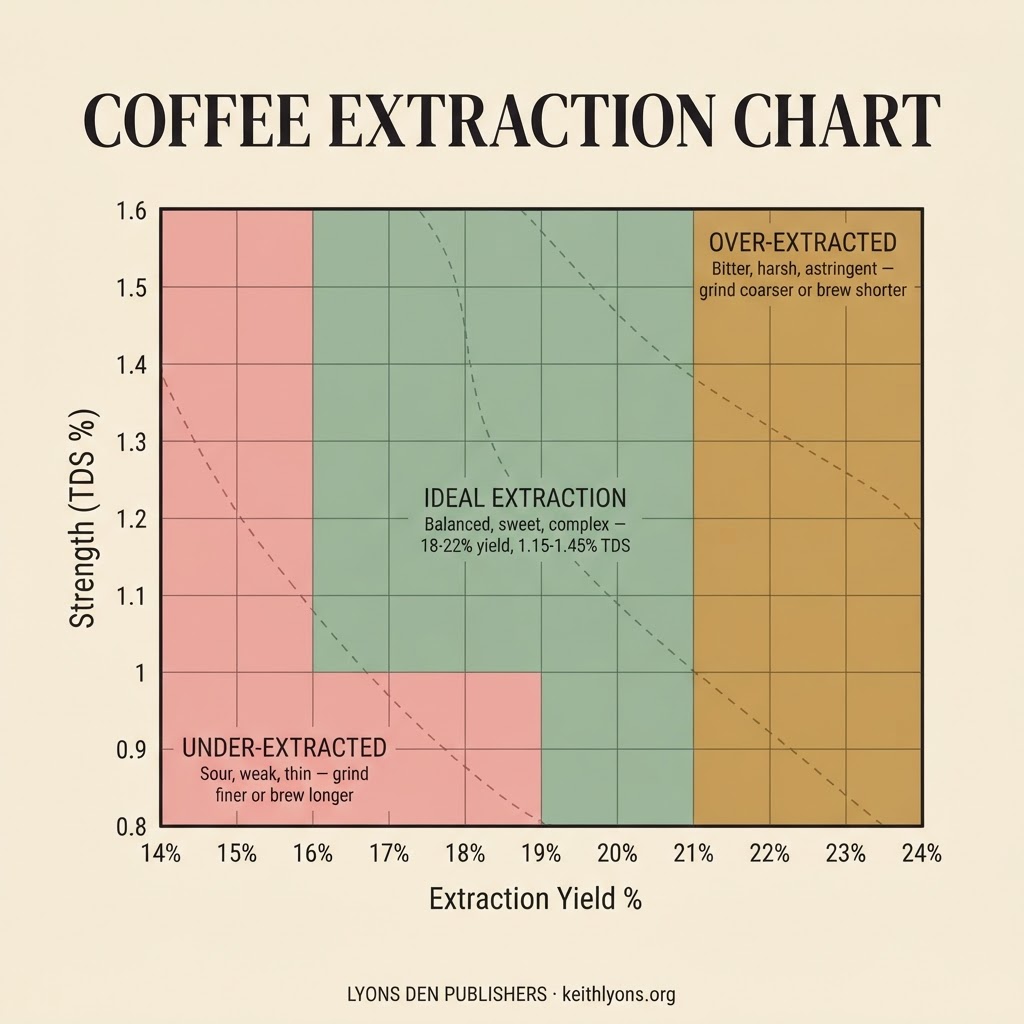
The 18–22% extraction yield range is a historical and practical reference band for conventional filter and espresso brewing, not a universal definition of quality. According to Wikipedia's entry on coffee extraction, yields below 18% are commonly described as under-extracted and yields above 22% as over-extracted. Those labels are conventions rather than physical thresholds. Coffee does not suddenly become bad at 17.9% or 22.1%.
Regional strength preferences show how much the target depends on culture. Wikipedia lists typical North American strength as 1.15–1.35% TDS. Nordic countries generally prefer 1.30–1.50%. European countries often land between 1.20% and 1.45%. These are descriptive norms, not rules. A brewer in Oslo and a brewer in Chicago may both produce excellent coffee at different strengths.
The band also shifts with roast level, coffee variety, processing method, and brewing style. Lighter roasts often benefit from higher extraction yields because their sugars and acids are less degraded. Darker roasts may taste best at lower yields because bitter compounds develop more readily. Some coffees taste best outside the 18–22% range entirely. Barista Hustle notes that extraction targets are best treated as starting points rather than fixed destinations.
The value of the range is that it gives brewers a shared language. When someone says a coffee is under-extracted, they usually mean the yield fell below roughly 18%. When they say over-extracted, they usually mean it exceeded roughly 22%. That shared reference makes troubleshooting easier, even though the boundaries are approximate.
Which variables actually change how much you extract?
The recognized extraction parameters include coffee-to-water ratio, particle size distribution, water temperature, contact time, agitation, flow rate, pressure, and water quality. A 2020 review in Food Research International lists extraction pressure, coffee/water ratio, water quality, contact time, particle size distribution, and temperature among the key variables. Each one influences how much material dissolves and how evenly it dissolves.
These variables are linked. Changing grind size alters flow rate, which alters contact time, which alters yield. Changing dose changes bed depth, which changes resistance and flow. No single dial works in isolation. A brewer who changes grind without adjusting anything else may see effects that look unrelated to grind at first.
Two common oversimplifications deserve correction. Finer grind does not automatically mean more extraction if it causes channeling or stalls flow. When water cannot move evenly through a very fine bed, it may bypass large portions of the coffee entirely. Longer contact time does not automatically raise yield if the water has already reached equilibrium with the grounds. In immersion brewing, extraction slows dramatically as the liquid approaches saturation.
Water temperature and mineral content are the two parameters home brewers most often leave uncontrolled. Temperature changes the rate at which compounds dissolve. Mineral content, particularly calcium and magnesium, changes how effectively water extracts flavor compounds. Both are measurable and adjustable, yet many home brewers focus entirely on grind and dose while ignoring them.
How do immersion, percolation, and espresso extraction differ?
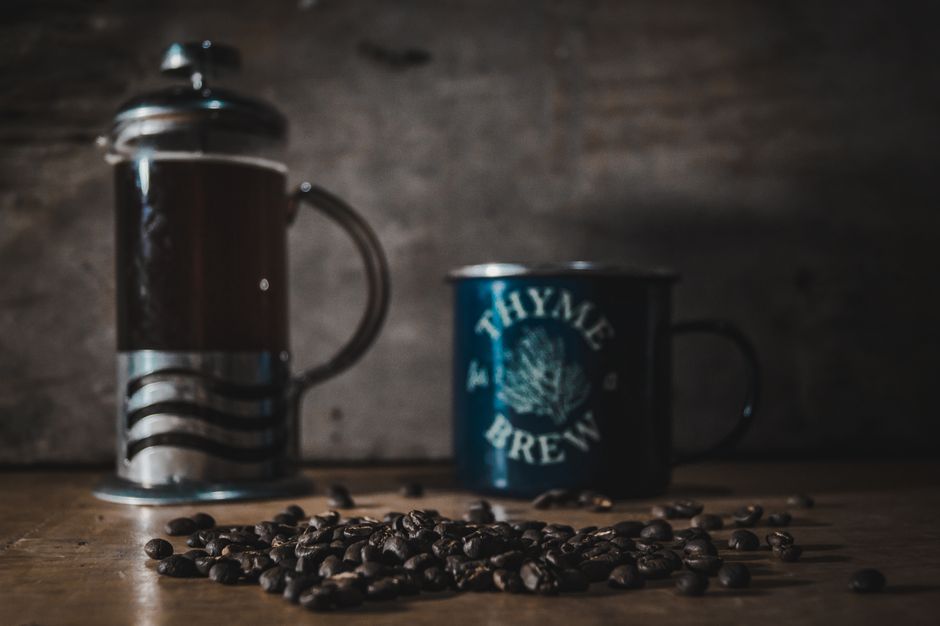
Immersion brewing is equilibrium-driven. Coffee and water sit together, and the brew approaches a maximum concentration before extraction slows dramatically. French press, cupping, and cold brew all work this way. Cold brew typically steeps for 12 to 24 hours at roughly a 1:4 coffee-to-water ratio, according to a 2024 video from Coffee Knowledge. The long time compensates for the low temperature.
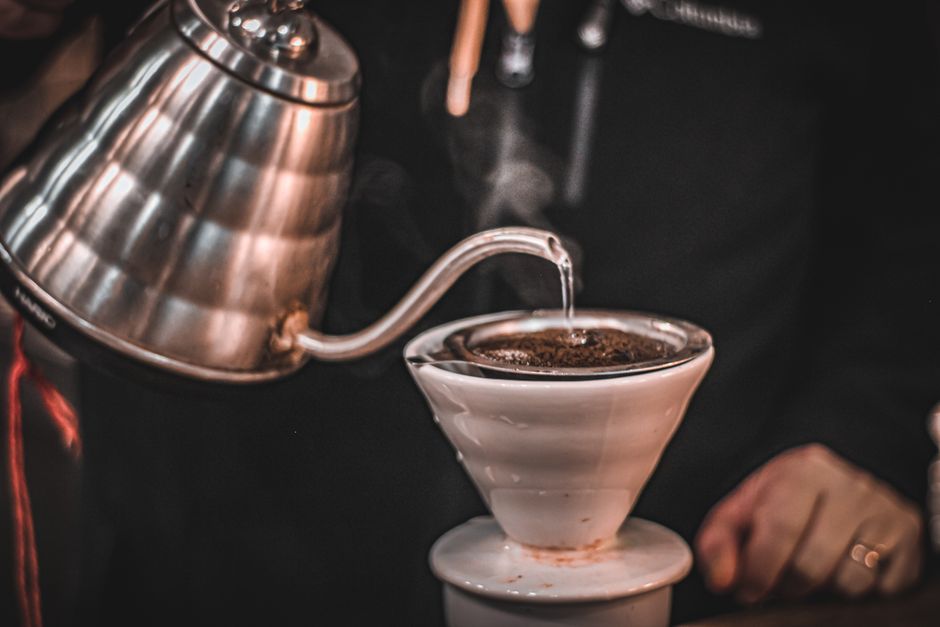
Percolation brewing is a continuous flow process. Fresh water keeps meeting fresh coffee, so the liquid around the grounds never reaches equilibrium. Drip and pour-over methods rely on this principle. Yield depends heavily on flow rate and evenness. If water flows too quickly, it leaves before extracting much. If it flows unevenly, some parts of the bed give up more than others.
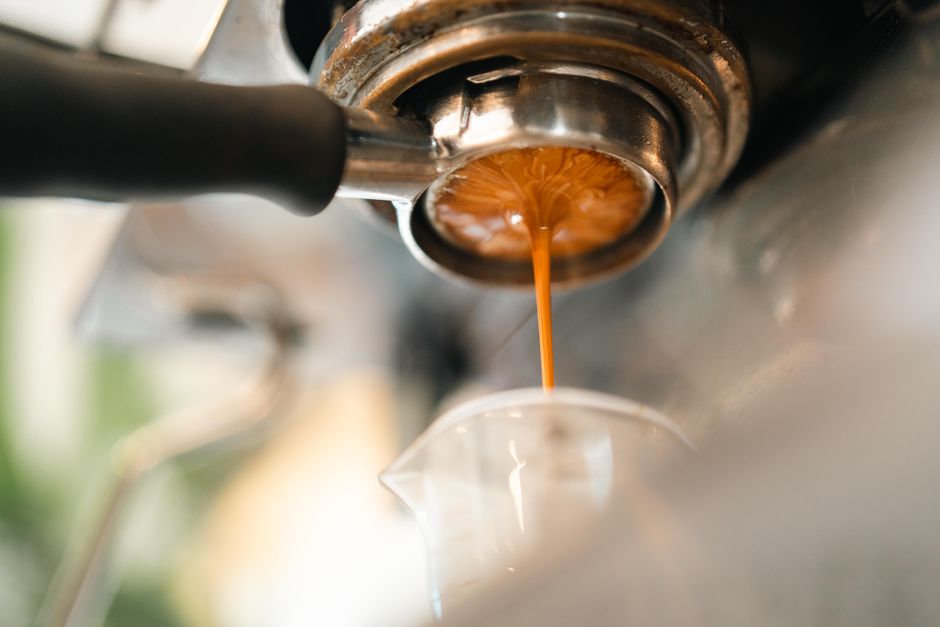
Espresso is high-pressure extraction through a fine, compacted bed. Water is forced through the coffee under pressure, producing a concentrated beverage of 7–12% dissolved solids. According to Coffee Knowledge, espresso extraction should run for about 25–30 seconds. The pressure and fine grind create a very different extraction environment from either immersion or percolation.
The three methods differ in how forgiving they are. Immersion is generally the most forgiving because extraction slows on its own. Percolation requires more attention to flow and evenness. Espresso is the least forgiving because small changes in grind, dose, or pressure produce large changes in the cup. What counts as even extraction also differs. In immersion, evenness is about particle saturation. In percolation, it is about uniform flow through the bed. In espresso, it is about the entire puck contributing evenly under pressure.
What do under-extraction and over-extraction really taste like?
Under-extraction is commonly associated with sourness, sharpness, and a thin or hollow finish, while over-extraction is commonly associated with bitterness and a drying, hollow quality. These are tendencies, not rules. Clive Coffee describes under-extracted coffee as sour or sharp and over-extracted coffee as bitter and thin, almost hollow. The descriptions are useful starting points, but they do not cover every case.
Sourness can come from the coffee itself, from water chemistry, or from low brew temperature. A naturally acidic coffee may taste sour even at a perfectly reasonable extraction yield. Water with the wrong mineral balance can mute sweetness and emphasize acidity. Low temperature slows extraction of sugars relative to acids, which can produce a sour cup without a low yield.
Bitterness can come from roast level or from suspended fines rather than high yield. A dark roast may taste bitter at a modest extraction yield because the roasting process created bitter compounds. Fines, the tiny particles produced by grinding, can over-extract quickly and add bitterness even when the overall yield is moderate.
Extraction evenness is often the more useful diagnostic concept. A brew can be simultaneously under-extracted and over-extracted in different regions of the bed. Channeling is the mechanism behind this unevenness. Water finds the path of least resistance and bypasses portions of the coffee bed, leaving some areas under-extracted while others over-extract. Barista Hustle emphasizes that evenness matters as much as total yield.
How do you troubleshoot extraction in practice?
Start by changing one variable at a time, tasting before measuring, and using yield and TDS as confirmation rather than as the goal. The numbers help you understand what happened, but the cup is the final arbiter. A scale, a consistent grind, and controlled water make any adjustment repeatable. A balanced drip starting point is about 60 grams of coffee per liter of water, according to Coffee Knowledge.
For a weak and sour cup, the first hypothesis is often under-extraction. Try a slightly finer grind, a longer contact time, or a higher water temperature. Change one of those and taste again. For a strong and bitter cup, the first hypothesis is often over-extraction or uneven flow. Try a slightly coarser grind, a shorter contact time, or a gentler pour. For inconsistent results from brew to brew, look first at grind consistency, water temperature stability, and pour technique.
Water chemistry deserves attention before blaming the coffee. If the water is too soft, extraction may be weak regardless of grind. If it is too hard, the cup may taste chalky or flat. Testing water and adjusting mineral content is one of the most reliable ways to improve repeatability.
For readers who want the full treatment of extraction, water chemistry, and brewing science, The Complete World of Coffee: A Guide to the History, Science, and Craft of Specialty Coffee covers these subjects in depth. The book is available in a Limited Edition, a Standard Edition, and an Electronic Edition, published by Lyons Den Publishers.
Key Takeaways
- Coffee extraction is a solid–liquid process, and roughly 28% of a roasted coffee bean's mass is water-soluble material available to be dissolved.
- Extraction yield measures how much of the coffee dissolved; TDS measures how concentrated the resulting brew is.
- Filter coffee typically contains about 1–2% dissolved solids, while espresso contains roughly 7–12%.
- The 18–22% extraction yield range is a useful historical reference band, not a universal definition of good coffee.
- Finer grind and longer contact time do not automatically increase extraction because flow, channeling, and saturation all intervene.
- Immersion, percolation, and espresso reach extraction differently through equilibrium, continuous flow, and pressure-driven flow through a compacted bed.
- Sour does not always mean under-extracted and bitter does not always mean over-extracted; evenness across the coffee bed is often the more useful diagnostic.
References
- Coffee Extraction and How to Taste It — Barista Hustle, January 30, 2017
- How Coffee Extraction Works — Clive Coffee, date unknown
- Coffee extraction: A review of parameters and their influence on the physicochemical characteristics and flavour of coffee brews — Food Research International, February 2020
- Coffee extraction — Wikipedia, date unknown
- Coffee extraction methods part 1 - Golden Rules for Brewing a Better World — Coffee Knowledge, September 6, 2024
Free Download
The Coffee Extraction Chart
Take the article with you to the brew bar: extraction yield vs. strength, with the under-extracted, ideal, and over-extracted zones labeled. Free, no gate — just save it.
The email field only subscribes you to the weekly coffee newsletter — downloads work either way.
Embed this chart
Use this chart in your own blog post or forum thread — the snippet links back here as the source.
<a href="https://keithlyons.org/blog/how-coffee-extraction-works" title="Coffee Extraction Chart — Lyons Den Publishers">
  <img src="https://media.base44.com/images/public/6a0f3687b259082fa2acf832/1e54190f9_generated_image.png" alt="Coffee Extraction Chart: extraction yield vs. strength, with under-extracted, ideal, and over-extracted zones" width="800">
</a>
<p>Chart via <a href="https://keithlyons.org/blog/how-coffee-extraction-works">Lyons Den Publishers</a></p>
Key Takeaways
- 1.Coffee extraction is a solid–liquid process, and roughly 28% of a roasted coffee bean's mass is water-soluble material available to be dissolved.
- 2.Extraction yield measures how much of the coffee dissolved; TDS measures how concentrated the resulting brew is.
- 3.Filter coffee typically contains about 1–2% dissolved solids, while espresso contains roughly 7–12%.
- 4.The 18–22% extraction yield range is a useful historical reference band, not a universal definition of good coffee.
- 5.Finer grind and longer contact time do not automatically increase extraction because flow, channeling, and saturation all intervene.
- 6.Immersion, percolation, and espresso reach extraction differently through equilibrium, continuous flow, and pressure-driven flow through a compacted bed.
- 7.Sour does not always mean under-extracted and bitter does not always mean over-extracted; evenness across the coffee bed is often the more useful diagnostic.
Sources
- 1.Coffee Extraction and How to Taste It — https://www.baristahustle.com/coffee-extraction-and-how-to-taste-it/ (Barista Hustle, January 30, 2017)
- 2.How Coffee Extraction Works — https://clivecoffee.com/blogs/learn/how-coffee-extraction-works (Clive Coffee, date unknown)
- 3.Coffee extraction: A review of parameters and their influence on the physicochemical characteristics and flavour of coffee brews — https://www.sciencedirect.com/science/article/abs/pii/S0924224419305692 (Food Research International, February 2020)
- 4.Coffee extraction — https://en.wikipedia.org/wiki/Coffee_extraction (Wikipedia, date unknown)
- 5.Coffee extraction methods part 1 - Golden Rules for Brewing a Better World — https://www.youtube.com/watch?v=5i9bwV3Kqg4 (Coffee Knowledge, September 6, 2024)
Written by
Keith E. Lyons
Specialty coffee author, educator, and founder of Lyons Den Publishing. Author of The Complete World of Coffee.